
Patio And Deck Lighting Installation in Westchester and Fairfield County, NY
Most outdoor living space goes unused after dark because nobody lit it properly. We install patio lighting, deck lighting, porch lighting, and hardscape lighting that makes those spaces work at night, without glare in anyone’s eyes. NY Landscape Lighting has installed outdoor lighting across Westchester and Fairfield County since 2005. Call 914-962-2095 for a design consultation.


EXCELLENT Based on 408 reviews
 Posted on Google
 Allison ReesJanuary 20, 2026Did a GREAT job with our holiday lights. So nice and genuine as well. Will be using them again!Posted on Google
 Karen HayesJanuary 14, 2026This was our first year using NY Landscape Lighting for our Christmas lighting needs. They were very professional, prompt and provided great communication. We wanted icicle lighting along our roof, and their lights were fantastic! Our house looked wonderful for the holidays! Looking forward to many years of doing business with them.Posted on Google
 Cheryl MckissackDecember 22, 2025The service is professional and they are very reliable. I have construction work in my house and my Christmas lights were somehow disconnected New York landscape was out at my house within a few hours to fix it.Posted on Google
 Michael PalottaDecember 1, 2025Work was completed in a professional manner and on time we are very satisfied with the design and servicePosted on Google
 Joseph SalvoNovember 29, 2025Chris Waugh is a polished professional. He is thorough and knowledgeable and responds in a timely fashion whenever needed. His staff are courteous, efficient and they get it right the first time!Posted on Google
 Racquel LG (Rocky)November 24, 2025Amazing company!! Our lights and decorations are above and beyond! Quick service, great workers!Posted on Google
 Ross RizzoNovember 10, 2025Installed our Christmas Lighting on our home for the 5th consecutive year. On time they do a great job very professional, would highly recommend.Posted on Google
 A BOctober 27, 2025Great products and service. Worked with Shane, who did an excellent job helping to select the correct lights while always being mindful of cost. He clearly cares about his work product and it shows. Would certainly recommend them to anyone.Posted on Google
 Shawn ScottOctober 20, 2025I am so happy with the work that was done by Shane and Manuel and their guys. Neat, clean and such an eye for detail. I highly recommend their service . They communicated every step of the way . OutstandingVerified by TrustindexTrustindex verified badge is the Universal Symbol of Trust. Only the greatest companies can get the verified badge who has a review score above 4.5, based on customer reviews over the past 12 months. Read more
Patio & Deck Lighting Installation — Westchester & Fairfield County
Patio, Deck, Porch, and Hardscape Lighting We Install
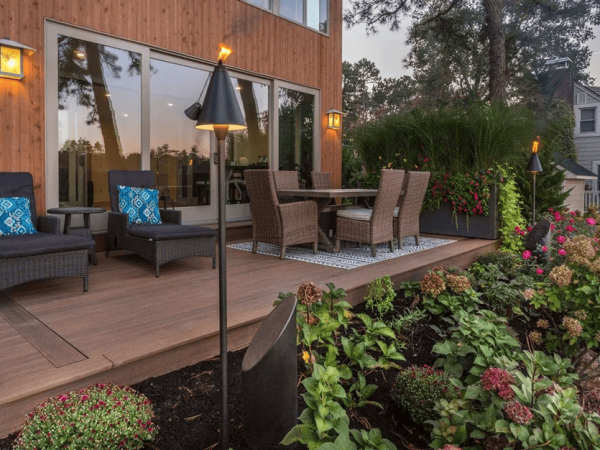
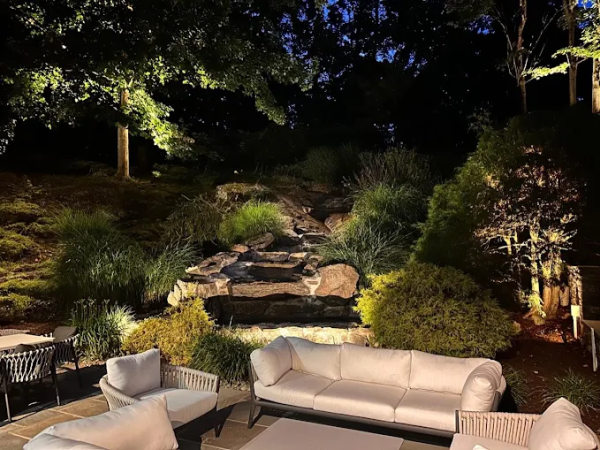
Patio lighting. We light patios from the perimeter in, using low-voltage fixtures set into planting beds, wall surfaces, and overhead structures. Seating areas get soft ambient light. Dining tables get enough light to eat by without a spotlight effect.
Deck lighting. Recessed step lights, riser lights, post cap lights, and under-rail strip lighting. We run wiring through the frame so nothing is visible from the seating side.
Porch lighting. Covered porches need layered light, not one bright fixture. We combine ceiling-mounted downlights with lower-level fixtures so the space reads warm instead of flat.
Hardscape lighting. Retaining walls, seat walls, steps, and paver edges. Fixtures mount under the cap stone and wash light down the face. Done right, you see the wall, not the fixture.
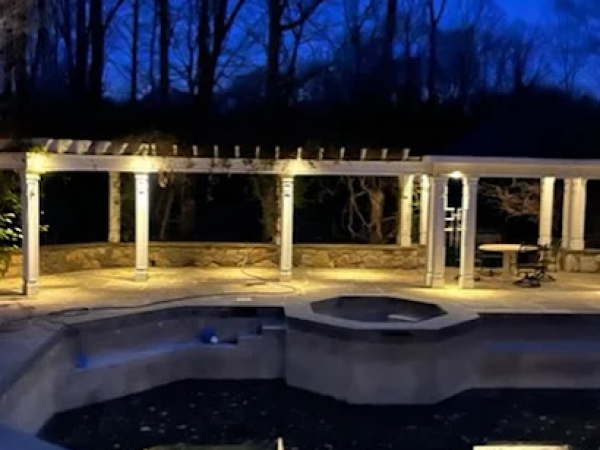
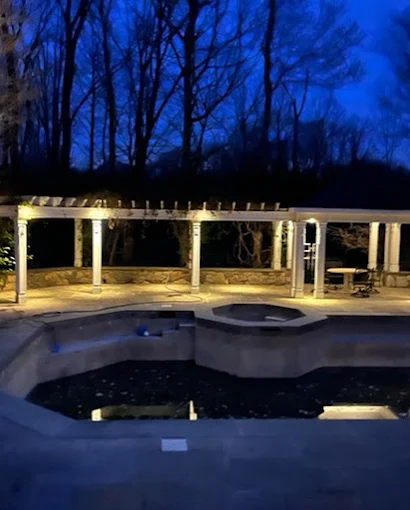
Pergola and overhead structures. Fixtures mounted into beams and rafters, aimed down at the table or seating below.
Want your patio usable after dark? Call NY Landscape Lighting at 914-962-2095. We design the layout on site, show you what it will look like, and quote before any work starts
About NY Landscape Lighting
Why Westchester County Homeowners Choose NY Landscape Lighting
We only do lighting. Landscapers and electricians install lighting between other jobs. Lighting is the whole business here, and has been since 2005. That shows up in fixture aiming, beam selection, and glare control.
We design at night. Anyone can place fixtures on a plan in daylight. We check the result after dark and adjust until it is right.
A patio is a seated space. People sit still and look outward for hours. A fixture angle that nobody notices walking down a driveway becomes the thing you stare at all evening from a patio chair. That is what we design around.
We service what we install. Fixtures move, lamps fail, plants grow into beam paths. We handle maintenance and repair on our own systems and on systems other companies installed.
Request Your Free Estimate Now!
How We Work
How We Design a Patio or Deck Lighting Layout
We do not sell fixture packages. Every layout starts on your property.
Site visit
We walk the patio or deck with you at the time of day you actually use it. We look at sight lines, where people sit, where people walk, and where light would land in someone’s eyes.
Design
We map fixture positions, beam spreads, and light levels. Steps and grade changes get lit first for safety. Ambient layers go in after.
Night demo
For larger projects we set temporary fixtures and show you the effect before we trench anything. You approve the look, then we install.
Installation
Low-voltage wiring is buried, run through deck framing, or channeled behind hardscape caps. Transformers are placed out of sight. No exposed cable across your patio.
Aiming and adjustment
We come back after dark and adjust every fixture. This is the step most installers skip, and it is the difference between a patio that looks designed and one that looks lit.
PRICING
What Patio and Deck Lighting Costs
Cost depends on the size of the space, how many fixtures the layout needs, and how hard the wiring runs are. The main variables:
Number of fixtures. A small deck may need six. A large patio with a seat wall, steps, and a pergola may need twenty five.
Surface type. Running wire through an existing composite deck takes longer than a new build. Cutting into finished hardscape costs more than lighting installed during construction.
Fixture grade. We install solid brass and copper. They cost more up front than aluminum and they do not fail after three winters in this climate.
Transformer capacity. If your existing system has headroom we tie in. If not, the project includes a new transformer.
We give a fixed quote after the site visit.
FIXTURES
Fixtures and Systems We Use
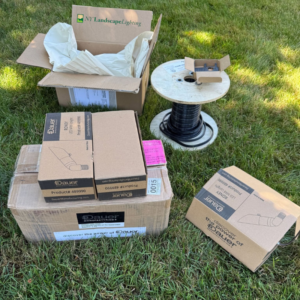
We install low-voltage systems only. Twelve volts at the fixture, which means no shock risk on a wet patio.
Fixtures are solid brass or copper. Both develop a patina and keep working. We do not install cast aluminum or plastic, because they corrode, crack, and get replaced within a few seasons in Westchester and Fairfield winters.
LED lamps throughout, at 2700K warm white. Colder color temperatures make stone and wood look grey. Warm white keeps bluestone, brick, and cedar looking the way they do in daylight.
Towns We Serve
We install patio, deck, porch, and hardscape lighting throughout Westchester County, NY, including Mount Kisco, Bedford, Chappaqua, Armonk, Scarsdale, Larchmont, Mamaroneck, Harrison, Katonah, Pound Ridge, North Salem, Somers, and Pawling.
We also install patio and deck lighting throughout Fairfield County, CT, including Greenwich, Darien, New Canaan, Weston, and Ridgefield.
Our shop is at 342 Lexington Ave, Mount Kisco, NY. Most of our service area is inside a forty minute drive.
COMMON QUESTIONS
FAQs
How long does a patio lighting installation take?
Most patio and deck projects take one to two days on site. Larger properties with hardscape lighting and multiple zones can run three days. We schedule the aiming visit for the week after installation.
Can you add lighting to a deck that is already built?
Yes. We run wiring through the existing framing from underneath, or channel it behind the fascia and rail. On a finished deck the wiring stays hidden. It takes longer than lighting a deck during construction, so it costs more.
Will patio lighting bother my neighbors?
Not if it is aimed correctly. We use shielded fixtures, low beam angles, and the lowest lumen output that does the job. Glare into a neighbor’s window is an aiming problem, not a fixture problem.
Can you connect patio lighting to my existing landscape lighting system?
Usually. We check the transformer capacity and the wire gauge on the existing runs first. If there is headroom we tie in. If not, we add a second transformer rather than overload the first.