

How a Landscape Lighting Design Comes Together
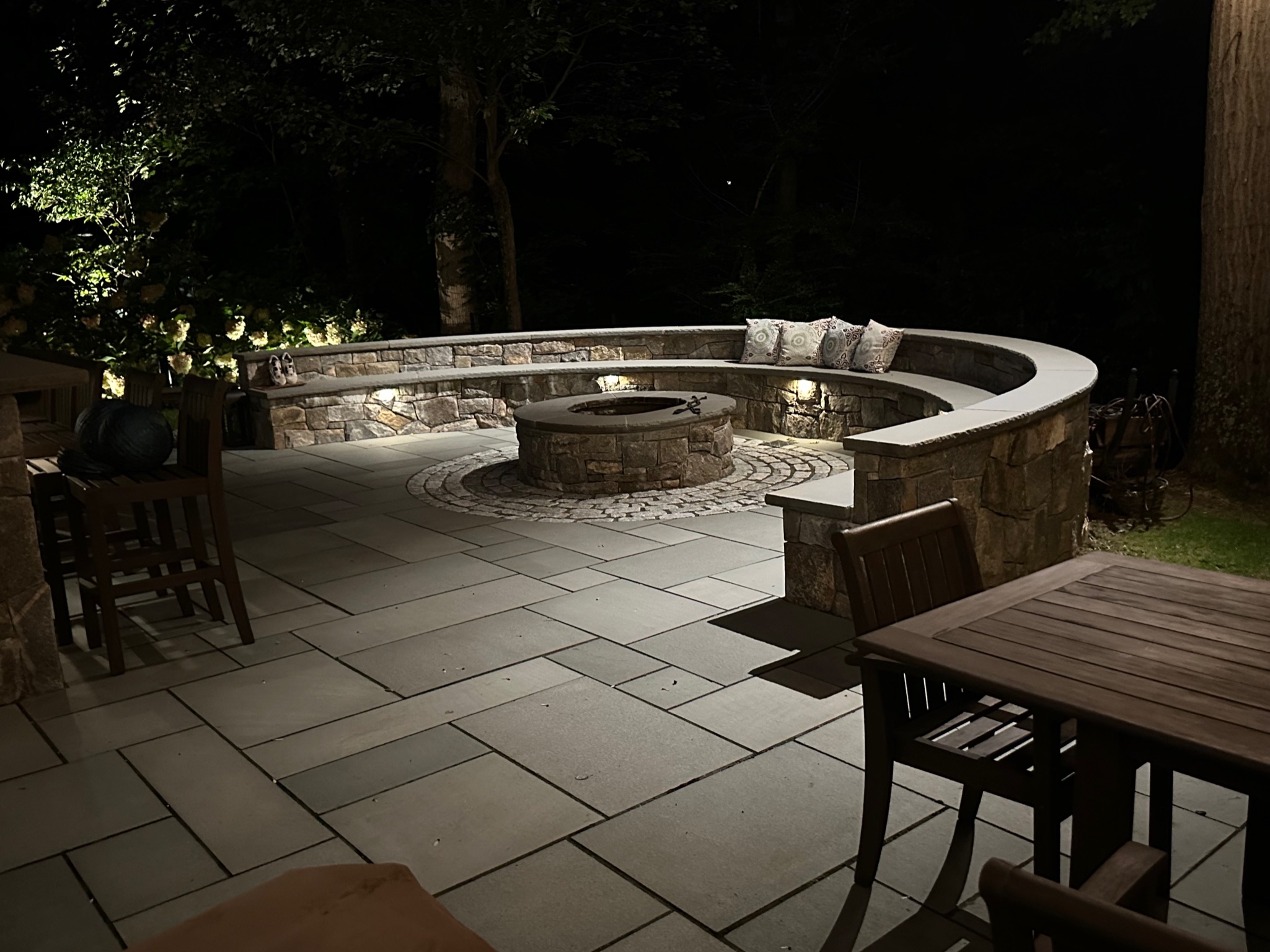
Upgrading the Look and Feel of Your Space Has Never Been Easier
Most people decide they want landscape lighting after seeing it somewhere else. A neighbor’s house, a restaurant terrace, a hotel driveway. What they are reacting to is almost never the fixtures. It is the decisions behind the fixtures.
A lighting plan is a set of those decisions written down. Here is how one gets made.
What a Landscape Lighting Plan Actually Contains
A landscape lighting plan is not a shopping list. It shows every fixture location, the beam angle at each one, the lumen output, where the transformer sits and how the wire runs between them.
More usefully, it says what each fixture is doing. One light grazes a stone chimney. Another washes a garage door so the driveway does not end in a black wall. A third sits behind a Japanese maple to throw its shape onto the lawn rather than lighting the tree itself.
If a fixture on the drawing has no stated job, it does not belong on the drawing.
The plan also records what stays dark. Contrast is what makes lit areas read. A property where everything is lit evenly looks flat, and usually looks like a parking lot.
Why Lighting Design Happens After Dark
Landscape lighting design happens after dark for a simple reason. Daylight tells you where things are. It tells you almost nothing about how they will light.
A daytime walk records the trees, grade changes, hardscape, planting beds and sightlines. That is the survey. The design happens on a second visit at night, with portable fixtures set out and moved around while someone stands where guests will actually stand.
This is where assumptions fall apart. A tree that looks like an obvious uplight candidate turns out to have a trunk more interesting than its canopy. A wall that seemed like a good surface throws glare straight into the front door. You find these out in twenty minutes with a portable fixture, or you find them out after installation.
Exterior Home Lighting and Wall Material
Facade lighting is mostly a question of what the wall is made of.
Stone takes a tight beam and a low mounting angle. The light travels across the surface rather than into it, which is what makes the texture read. Push the angle out and the stone goes flat.
Painted clapboard is the opposite problem. A tight beam turns every board edge into a hard stripe. Clapboard wants a wider, softer wash from further back.
Brick sits between the two, and stucco is unforgiving of any unevenness in the beam.
Tree Lighting for Mature Specimens
Tree lighting on large specimen trees is usually where a design either works or does not.
Uplighting from grade suits trees with structural trunks and open canopies. Oaks, sycamores, older maples. The light climbs the trunk and catches the branch structure.
Dense canopies do not respond to this. The light hits the underside of the leaves and stops, and you get a glowing green ceiling with a dark trunk underneath it. Those trees want downlighting instead, with fixtures mounted high in the canopy aimed down through the branches. The effect on the ground looks like moonlight through leaves, and it lights the space under the tree rather than the tree itself.
Walkway Lighting for Paths and Steps
Walkway lighting is the part most often overdone.
The instinct is to line both sides of a walk at even intervals. The result is a runway. Light is not doing any work there beyond announcing itself.
A better approach lights the walk from fixtures set off the path, or from a small number of well-placed units that pool light where it matters. Direction changes. Grade changes. The top and bottom of any step run. Between those points the pools of light do the guiding and the gaps do no harm.
Landscape Lighting Fixtures That Survive the Design
Landscape lighting fixtures are where a good plan quietly comes undone, and the difference shows up in year four rather than year one.
Cast brass and copper weather rather than fail. They darken, they patina, and they keep their seals. Aluminum is cheaper up front and corrodes at the lens gasket and the stake collar, which is where water gets in. Once a fixture fogs internally, aiming it correctly no longer matters.
The same applies to what is underground. Wire gauge has to match the run length or the far end of the circuit dims. Connectors have to be rated for direct burial, not wrapped and buried and hoped over.
Retail shelves carry very little of this. The professional landscape lighting fixture a plan like this calls for come out of trade supply, where the brass is solid rather than plated and a replacement part is still available years after the system goes in.
Designing a Landscape Lighting System in Phases
A landscape lighting system on a larger property is often built in stages. Front elevation and entry first, then rear grounds, then specimen trees and any pool or patio areas.
Phasing is fine. Phasing without a full design is not.
The transformer and the wire runs have to be sized for the finished system, not for phase one. Skip that step and phase two arrives needing a second transformer, a second wire path and often a second set of fixtures that do not match the first. The design exists partly so the last phase looks like it was planned at the same time as the first, because it was.
Working With Our Team
NY Landscape Lighting has designed and installed lighting, and only lighting, since 2005. If you are working through a plan for your own property, you can see how we approach design and installation or call us at 914-962-2095.